
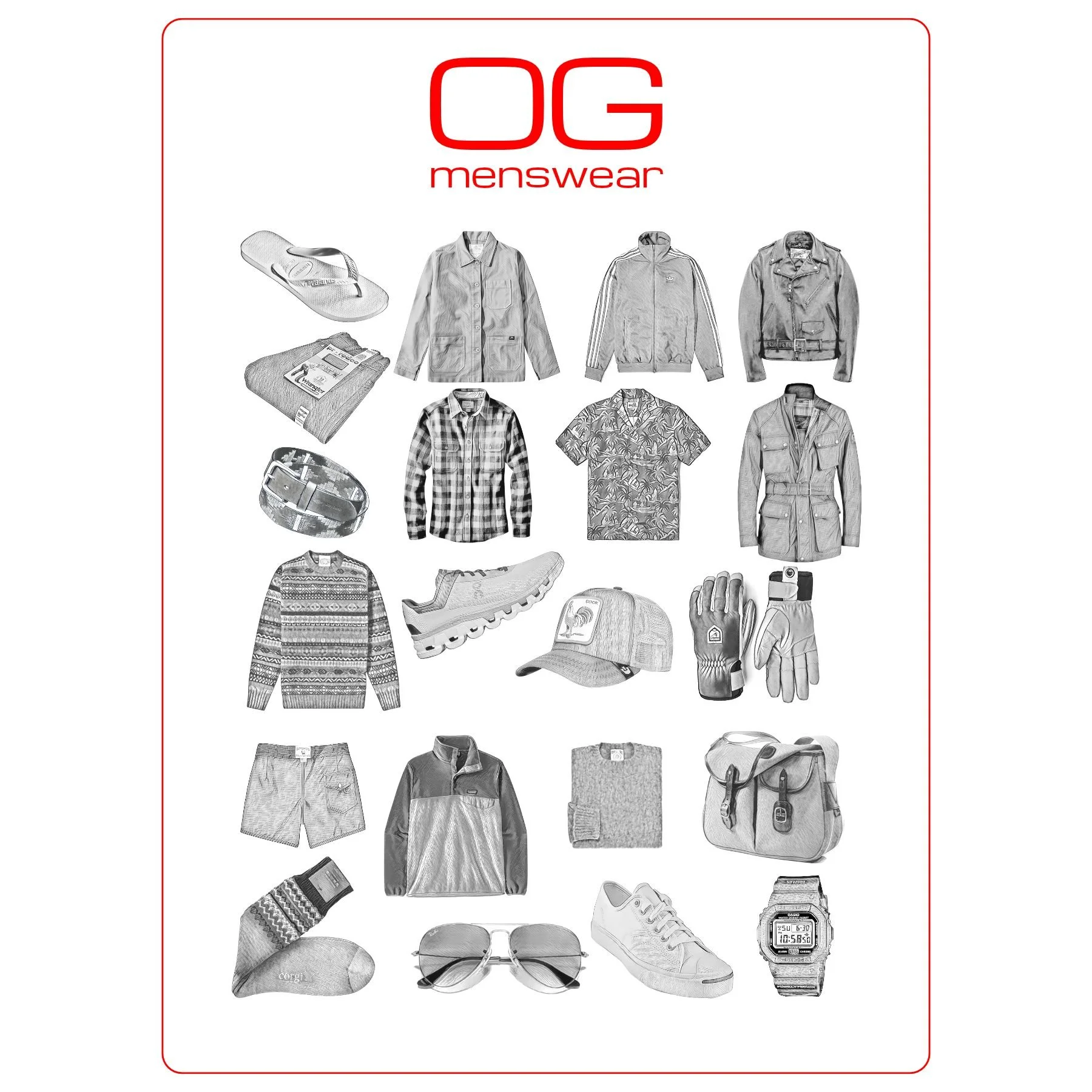
A compendium of enduring menswear
Twenty years ago, I took a job as a product developer for Baird Menswear Brands in Leeds, UK. At the time, they owned Baracuta, and within a few weeks I had learned something that inspired me, in my free time, to start compiling this compendium. The firm's best-known product, a short, zip-fronted cotton jacket called the G9, had been on sale more or less unchanged since the 1930s. And yet two of the most closely watched names in fashion at the time, Stüssy and Junya Watanabe, were keen to put their names alongside it, so a little of its history might rub off on them.
The jacket's story is an exemplary one, and it turned out to be archetypal for the garments featured in this compendium.
John and Isaac Miller were Manchester rainwear makers who had done well manufacturing full-length Mac coats for storied brands like Burberry and Aquascutum. As the business prospered, they took up golf. In 1937, they developed a weatherproof, hip-length jacket with a poplin shell, elasticised cuffs, room to swing a club and a vented, umbrella-shaped yoke across the back to let the rain run off. They called it the G9, the "G" referring to golf.
The jacket didn't stay on the golf course. It crossed the Atlantic and was taken up by American students then film stars, Steve McQueen among them, before returning home to an entirely different constituency. In 1966, British "Ivy League" menswear specialist and Baracuta retailer John Simons promoted the G9 as a "Rodney Harrington Jacket" after the character in the television series Peyton Place. Soon after John Simons started selling the 'Harrington Jacket', Eric Clapton appeared with The Yardbirds on Ready, Steady, Go! wearing a G9. The mods had found it.
As I looked at other long-lived menswear designs, I found the same story repeating itself with surprising consistency. I have come to call these garments OG menswear, borrowing the slang for the original article, the one everything else is measured against. They share a recognisable set of traits.
They begin with a particular man and a particular problem. The golfer, the hunter, the fisherman, the soldier, the farm labourer: each needed something that would do a specific job, and somebody built it for him. Every detail that defines the design and now looks decorative was once a practical solution.
They are then adopted by people who never had the original problem at all. In the case of the G9, the preps first, then the mods, later the football terraces, took up what was once a golf jacket. Each new group brings its own meaning and somehow strips away none of the old ones.
They are frequently better understood abroad than at home, and nowhere more so than in Japan, where Western workwear, sporting and Ivy clothing has been studied with a scholarly seriousness. Frequently a British or American design can be treated like a museum piece in Tokyo while being seen as merely old-fashioned in the country that made it.
They have continuity of design, which is not the same thing as continuity of ownership. Firms change hands, sometimes many times; production moves between countries and occasionally continents. What matters is that a specific, named product has stayed in production, recognisably itself, for decades. That is the test every subject on this compendium must pass.
They are accessible. These are not luxury goods. They are sold widely and are affordable, at least as an investment piece. You don't need to be rich to own the real thing rather than a copy.
And finally, younger brands come looking for them. Collaborating with an established original as a way to borrow a history they’ve not yet had time to acquire.
The articles on this site follow each of these garments through the same sequence: who made it and why, what problem its design solved, who adopted it and how it travelled, who copied it, and whether it is still made as it once was. Maybe you already know these clothes and want the full story, or maybe you've never given them a thought and are surprised to find you've been wearing a small piece of social history. Either way, I hope you find them as interesting and enjoyable to read as I found them to research.