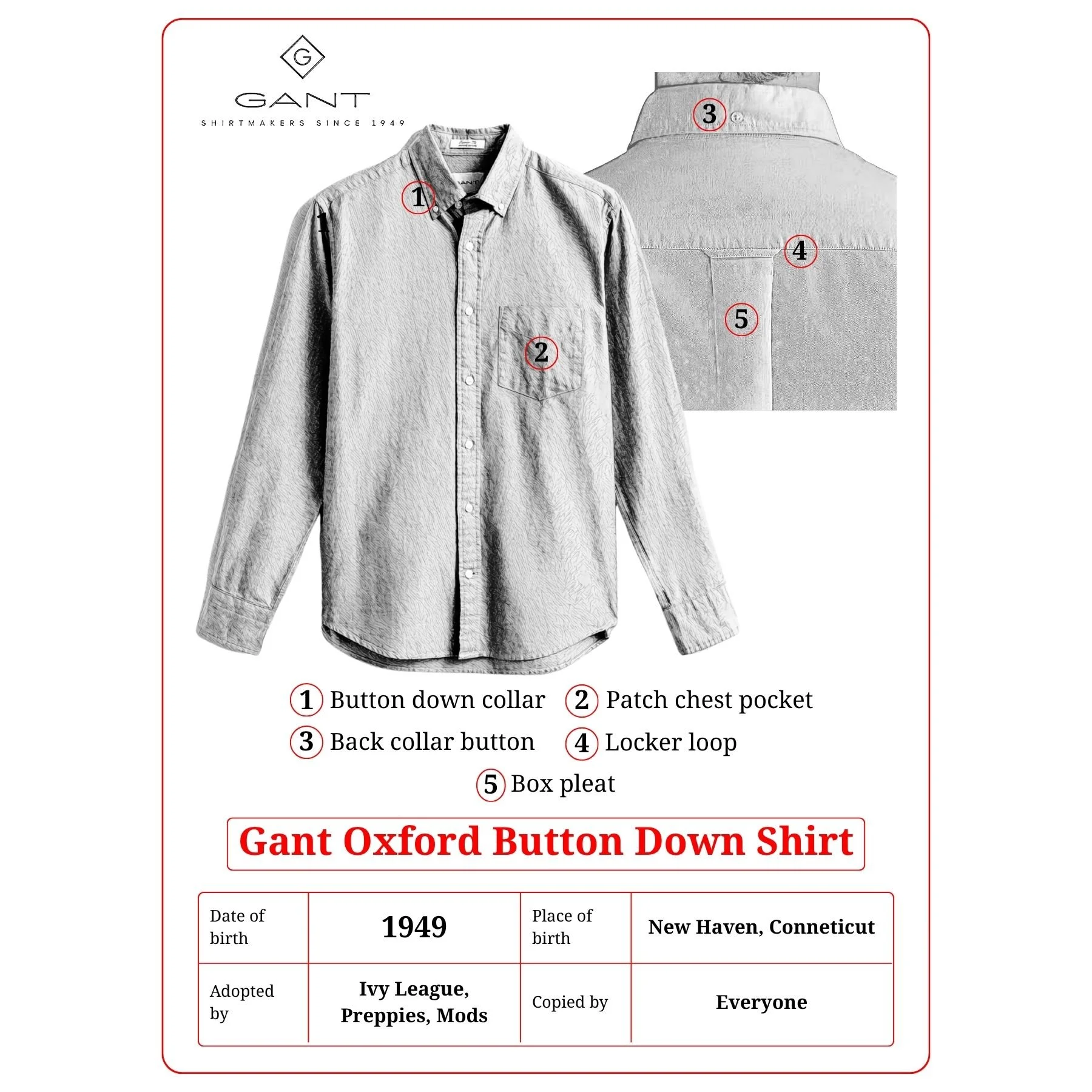
The Oxford cloth button-down shirt is perhaps the single most enduring and ubiquitous garment in the menswear canon. Adopted by Ivy League students in the 1950s, copied by every major shirtmaker since, it has never gone out of fashion; it has become a staple. Its modern form owes more to one brand more than any other.
Berl Gantmacher was a miller's son from Miropol, Ukraine, who emigrated to New York in 1907, aged just 17. He found work in the city's garment district as a closer, someone who assembles garments, where he met Rebecca Rose, a woman who sewed buttonholes and buttons for a living, whom he married. After fighting for the US Army in France during the First World War, he returned to New York and, with a partner, Morris Shapiro, founded the Par-Ex Shirt Company in Brooklyn, making shirts for other brands, including Brooks Brothers.
His sons, Marty and Elliot, encouraged Berl (who by now had Americanized his name to Bernard) to move away from contract manufacturing for other brands, and in 1949, they established their own brand, GANT. The company was founded in New Haven, Connecticut, the college town home to Yale University, where the Yale Co-op was among the first shops to stock its shirts. Quickly embraced by Yale students, their popularity spread across campuses, becoming a fixture of preppy Ivy League style, arguably the most influential look in menswear over the last half century.
The button-down collar shirt had been introduced earlier by Brooks Brothers, originally designed with the collar tips buttoned to the shirt to prevent them from flapping. So GANT did not invent the Oxford cloth button-down shirt, but it did refine, define and popularise it.
Several distinctive features of the Oxford shirt originated with Gant: a button on the back of the collar to keep a tie in place, a back box pleat for roominess, and the "locker loop", a small loop at the pleat meant for hanging a shirt on a hook in a locker.
That locker loop took on a life of its own as a social signal; a man would remove his shirt loop when he was "going steady" with a woman, and she, in return, would wear his scarf.
They also paid close attention to the collar's shape, promoting what they called the "perfect roll."
GANT also broke with the conventions of its era through its use of colour. In the 1950s, the prevailing colour for a man's shirt was white, until GANT introduced a range of coloured Oxfords and Madras-style checks, sparking what became known as the "Oxford Colour Explosion"
By the mid-1950s, the Diamond G, a small diamond with a "G" on the tail of the shirt, had become a distinctive sign of quality and authenticity.
The Oxford cotton button-down shirt remains the brand's anchor piece. The back collar button, locker loop, and box pleat are three iconic GANT inventions that remain central to its design across the multitude of brands that now offer an OCBD.