
The “original” Dr Martens, a boot that would become one of the most culturally loaded objects in modern fashion.
The story of Solovair starts with a factory. NPS Shoes (Northamptonshire Productive Society) was founded in 1881 in Wollaston, a village in England's historic shoemaking county. Northamptonshire was the centre of British footwear since the Civil War, with local cobblers supplying Cromwell's New Model Army. By the Victorian era, towns like Northampton, Kettering, and Wellingborough made millions of pairs annually, with skills of clicking, lasting, and welting passed down for generations. NPS was founded as a cooperative, giving workers a stake in production, a genuinely radical idea at the time. Boots were made by working men, for working men.
In 1959, R. Griggs & Co., a Wollaston-based bootmaker that had been producing agricultural and work boots since 1895, licensed a German patent from Klaus Märtens and Herbert Funck for an air-cushioned sole. Griggs anglicised the name to "Doc Martens," adapted the sole profile, added the iconic yellow welt stitching, and launched the 1460 boot on April 1, 1960.
NPS, Griggs's near neighbour, helped make those early boots and continued to use the Goodyear-welted air-cushion construction. When Griggs moved production offshore in the late 1990s, NPS continued to make the boots in Wollaston, preserving their identity: British-made, Goodyear-welted, genuine leather, cushioned-sole workwear.
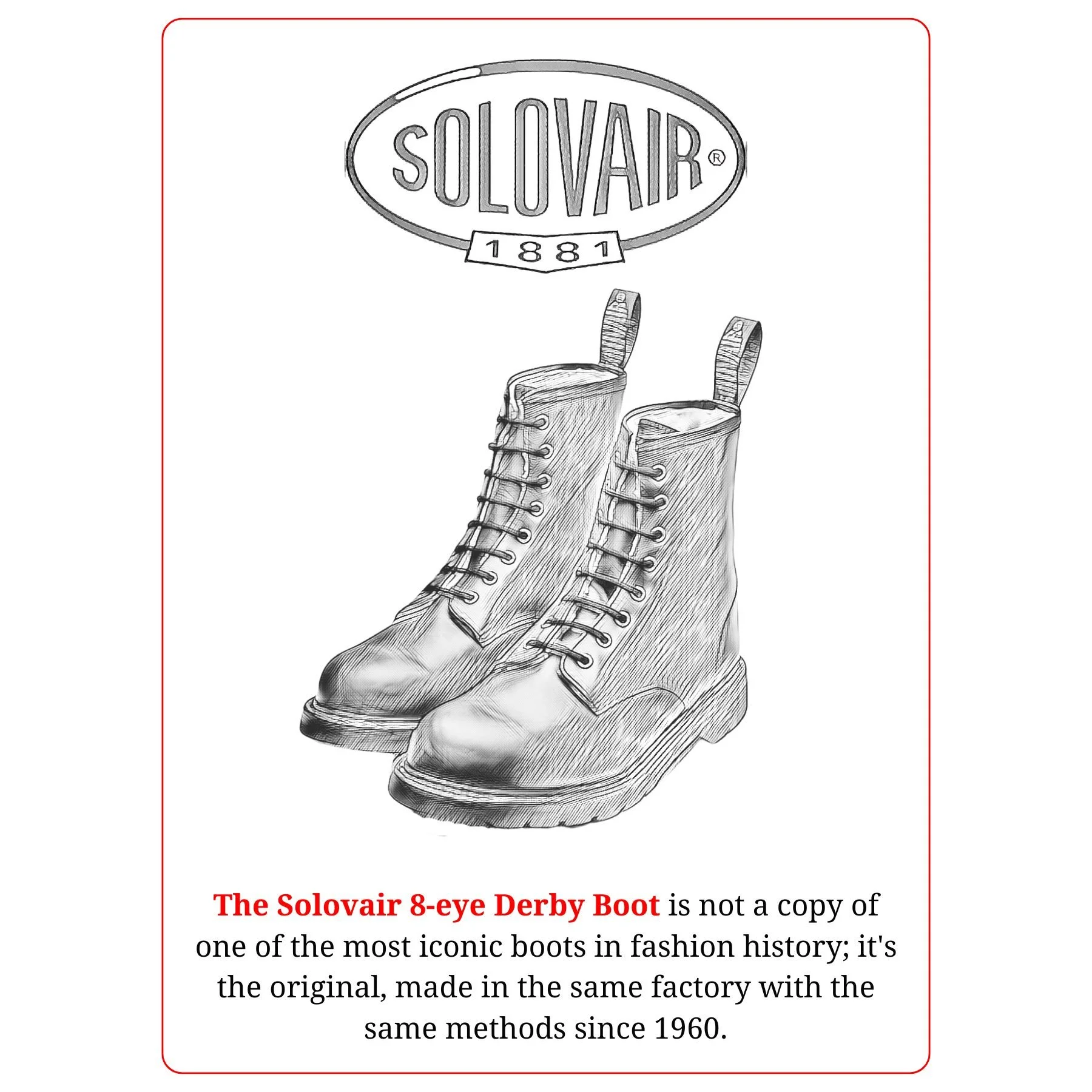
After Griggs moved production, NPS rebranded as Solovair (sole of air) and continued making its 8-eye derby boot with the same lasts, welt stitching, and factory workers.
The 8-eye derby boot is Goodyear-welted: the upper and insole are stitched to a welt, which is then stitched to the outsole. This construction allows for resoling and gives the boot its durability and structure. The air-cushion sole, a layered PVC unit with air pockets, provides a distinctive bounce and lends the silhouette its chunky, assertive profile.
The 8-eye derby silhouette became a defining subcultural boot of the 20th century. Adopted by British skinheads in the late 1960s and working-class youth, it was worn with Sta-Prest trousers and braces. In the 1970s, it crossed into punk with bands like The Clash and The Jam. It progressed through post-punk, goth, and grunge, worn by icons from Pete Townshend to Kurt Cobain, always carrying an undertone of defiance.
When Griggs moved production to Asia in the late 1990s, mainstream boot quality declined noticeably. Enthusiasts began seeking Solovair as the authentic continuation. Among British skinheads, Solovair holds status for its unbroken manufacturing lineage.
Made in the same factory, by the same hands and methods, Solovair stands today not just as the original, but as the true heir to a legacy of British bootmaking.