
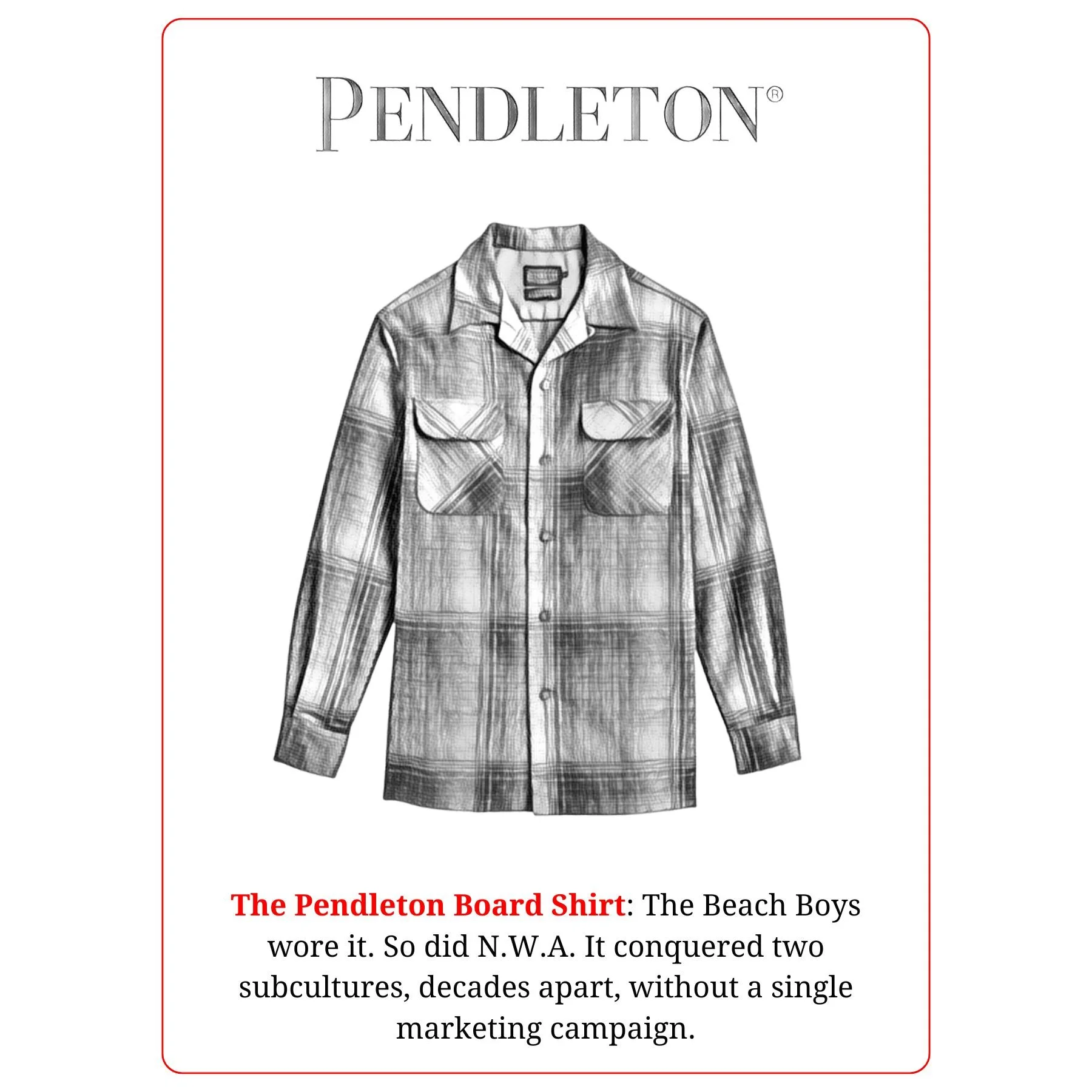
Pendleton's Board Shirt gained cultural traction not once but twice, through two entirely separate subcultures separated by decades.
Pendleton Woolen Mills dates to 1863, with the family-owned operation founded in 1909 in Pendleton, Oregon. The company built its reputation making wool blankets and robes for Native American tribes. These relationships and patterns shaped the brand's visual identity for over a century. Their wool fabrics were warm, durable, and tightly woven, earning a reputation for quality in the Pacific Northwest wool trade.
Emerging from this tradition in the 1920s, the shirt that would become the Board Shirt began as a practical outdoor and work garment. Designed as a sturdy wool overshirt in plaid patterns, it was cut with enough room for layering.
In the early 1950s, Pendleton shirts appeared in Pacific Northwest and Western collegiate culture. Throughout the decade, they gained visibility in early Ivy Style documentation and, by the late 1950s, were favoured by the traditional American sportswear crowd.
The Pendleton wool shirt found an unlikely second life in the early 1960s, embraced by the nascent surf culture of Malibu and South Bay. Surfers appreciated that the heavy wool offered genuine warmth after cold Pacific sessions, while the overshirt format worked well over board shorts or jeans. It became so synonymous with surf culture that it was known as "the Board Shirt", worn before and after surfing, not on the board itself.
The Beach Boys canonised this look on their early album covers by wearing matching Pendleton shirts. Following them, Dick Dale and the broader surf scene adopted the style. Soon after, a wool shirt from Oregon became the uniform of a youth movement.
Meanwhile, Pendleton shirts were embraced by Chicano youth culture in East Los Angeles and across the broader Southwest. The shirts became staples of the lowrider and pachuco aesthetic, worn buttoned only at the top over white t-shirts or tied at the waist, creating a distinct silhouette.
This Chicano heritage led straight into early West Coast rap. N.W.A., Snoop Dogg, and others wore Pendleton shirts in the unbuttoned overshirt style. The shirt appeared on album covers and in videos as West Coast hip-hop hit national prominence. Once again, the Board Shirt became a youth style through organic adoption.
The Board Shirt’s journey is remarkable because it was not planned. The same wool plaid shirt, simply made and consistent in quality, took on new cultural meanings among surfers, Chicano communities, and hip-hop fans, none of it steered by Pendleton. The company mostly made workwear and blankets, and watched as its products became symbols for movements it was not linked to.
The shirt hardly changed during these different adoptions. Surfers in 1961 and rappers in 1991 wore nearly identical garments. This is why the Board Shirt has lasting credibility and is still made today, rather than just a heritage reissue.