
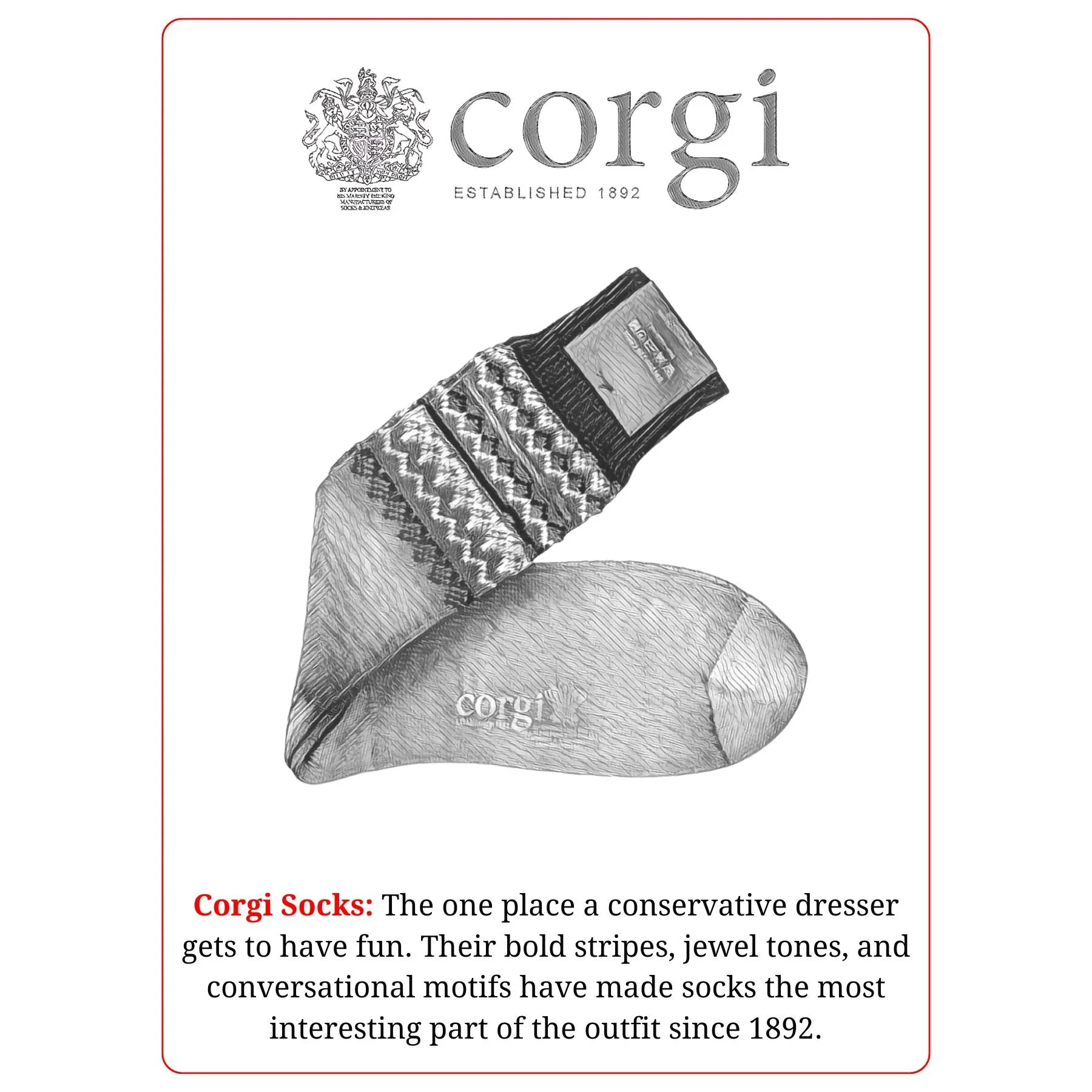
Few garments show as much personality as a well-chosen pair of socks. No British brand has done more to establish that notion than Corgi. Founded in the Welsh valleys in 1892, this small family mill built its reputation on hand-linked seams and fine-gauge yarns. Corgi has kept both its craft and humour through more than a century of industrial change.
Corgi was founded in 1892 in Ammanford, a small town in the Carmarthenshire valleys of South Wales. The region already had a strong textile tradition, with the wool trade forming its economic backbone for centuries. The company began as a small family operation producing hand-framed knitwear, emphasising quality over volume from the start.
The name "Corgi" appeared in the 1930s, honouring the Welsh dog breed that became tied to national identity and later the Royal Family.
What distinguishes Corgi is hand-linking: joining the toe to the sock by hand. Machines do this quickly, leaving a slight ridge, but hand-linking creates a seamless, flat finish. This painstaking, slow work requires skilled operators. Still, Corgi never abandoned it, even when mass production made the skill commercially inconvenient.
Their yarns reflect the same values: Sea Island cotton, merino wool, and cashmere, sourced for quality and knit at a finer, denser gauge than most competitors.
Corgi holds a Royal Warrant, supplying the Royal Family and securing its place at the top of British hosiery.
However, despite royal connections, Corgi never became formal or stuffy. Bold stripes and witty motifs often appear in unexpected colour combinations. These socks have a humour that appeals to men who enjoy a flash of colour. Aristocratic credentials meet playful irreverence.
They are a favourite in heritage and Ivy League menswear circles. Socks are often the only place for conservative dressers to show personality. Bold stripes, rich jewel tones, and classic argyle owe much to the visual language Corgi established.
The brand also shaped the conversation around slow manufacturing and retained craft. While most British hosiery moved offshore, Corgi stayed in Wales, remaining among the few making British hosiery at scale.