
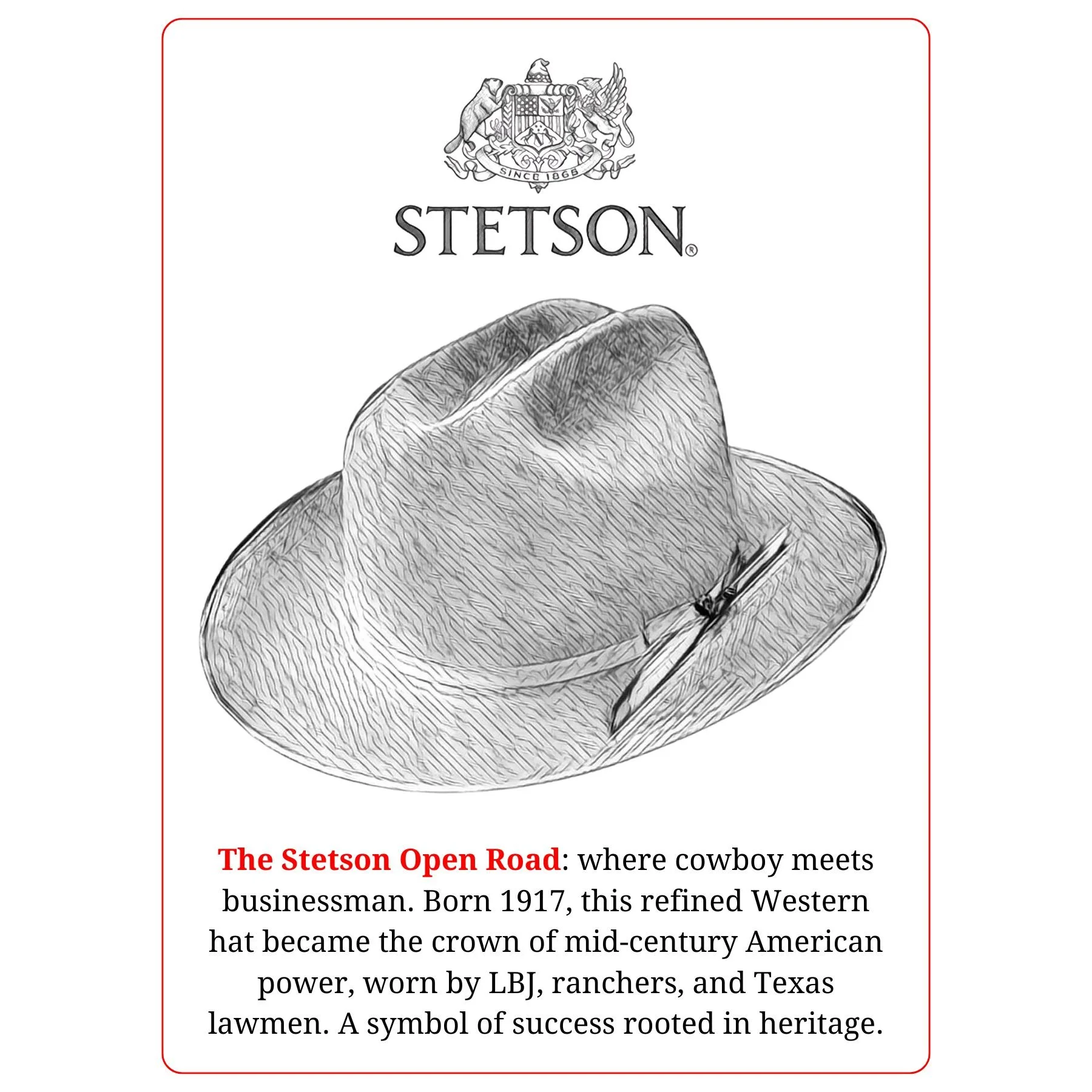
The Stetson Open Road stands out in American hat-making history. It connected practical cowboy gear with more polished civilian style, and became a symbol of American masculinity in the mid-1900s.
The Open Road debuted in 1917, created by the John B. Stetson Company as a more refined take on the classic Western hat.
Instead of the tall crowns and wide brims seen on frontier cowboy hats, the Open Road had a moderate 2⅝-inch brim with a bound edge. The hat was usually made from high-quality fur felt, either beaver or rabbit, and came in classic colours like silverbelly (a light grey), black, and different shades of brown. The design was meant to be versatile; formal enough for town, but still practical for the range. This mix of qualities became its biggest advantage.
The Open Road was most popular from the 1940s to the 1960s. During this time, it became the go-to hat for ranchers, businessmen, politicians, and lawmen throughout the South and West. It stood for prosperity and authority, but without being flashy. Lyndon B. Johnson was probably the hat’s most famous fan. He wore his Open Road so often that Stetson made a special "LBJ model" in silverbelly just for him. When Johnson became president, the Open Road became the unofficial hat for Texas power brokers and helped link the style to Southwestern political influence. Johnson wasn’t the only one. Many sheriffs, Texas Rangers, oilmen, and cattlemen wore the hat during the mid-1900s. It was the hat for people who had made it, respected, established, and successful. For many, it was a way to keep a connection to Western heritage and values, even if they no longer worked as cowboys.
Movies helped build the Open Road’s mystique. While older Westerns showed more traditional high-crowned hats, films set in the mid-1900s West often featured the Open Road. It became a visual symbol for the respected lawman or successful rancher, showing the difference between a drifting cowboy and a settled, successful one.
The Open Road lost influence as fewer Americans wore hats in the 1970s. As casual dress became more common and Western wear faded from mainstream fashion, the Open Road was mostly worn in ranching communities and by traditionalists in the Southwest. Still, the Open Road never fully disappeared. It stayed popular with rodeo officials, at Western heritage events, and among people in ranching and livestock who valued tradition and practicality. In Texas and the Southwest, it was still seen as proper business wear well into the 2000s.
Today, Stetson still makes the Open Road, though it fills a smaller niche. There’s some renewed interest from heritage fans and people who like classic American style, much like the comeback of vintage workwear. The hat reminds people of a time when regional dress codes mattered and Western wear stood for real values and social status, not just fashion or costume.
The Open Road is a functional design that evolved into a cultural signifier, carrying meaning far beyond its practical purpose. It represented a particular vision of American success and authority, rooted in Western tradition but refined for modern life. Unlike some items that crossed into broader subcultures or global fashion, the Open Road remained more geographically and culturally specific, which explains both its powerful regional symbolism and its limited contemporary reach. However, unless you work on a Ranch or cosplay Yellowstone, it is arguably an easier wear with a modern outfit.