
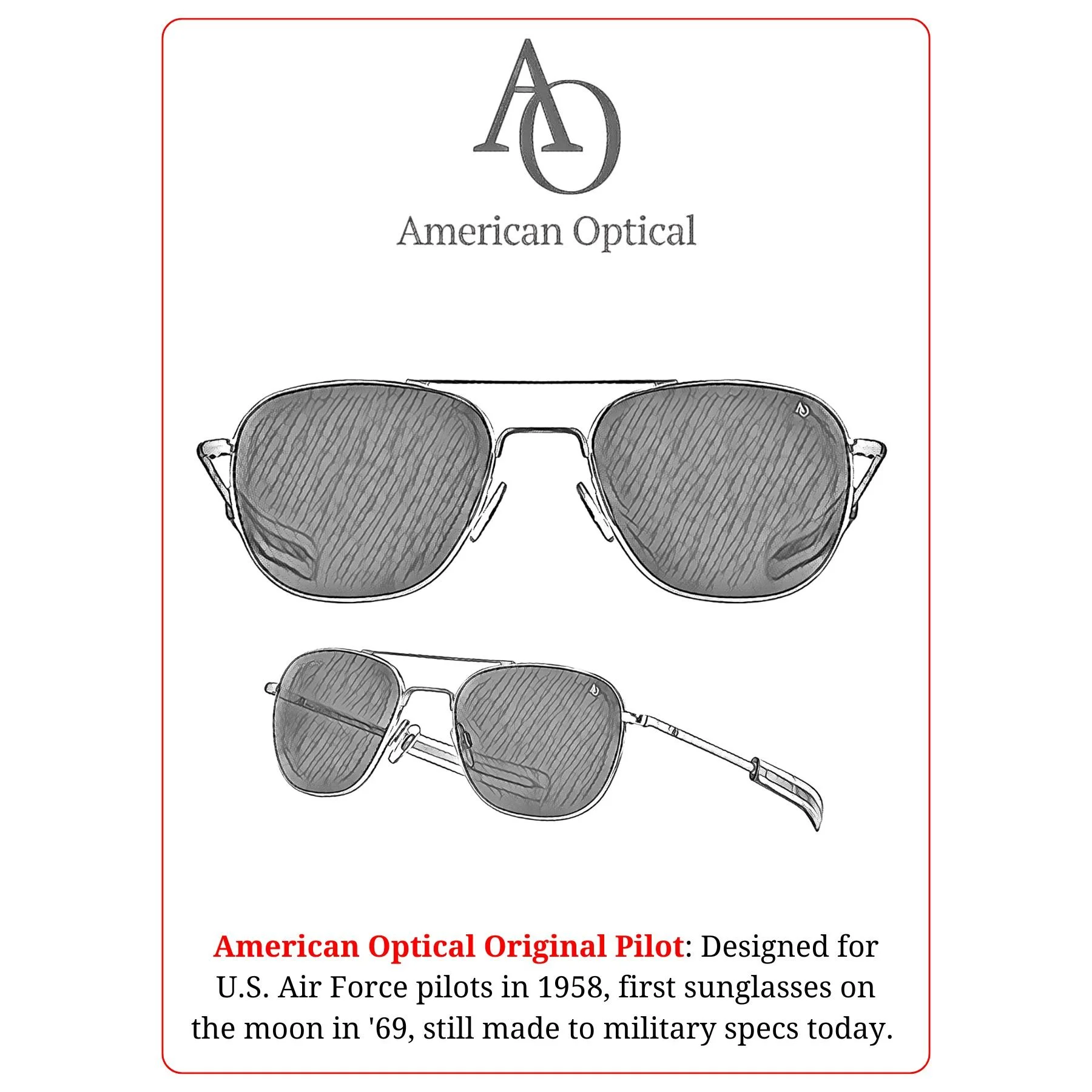
The American Optical Original Pilot started as a practical piece of military equipment and eventually became a cultural icon.
In 1958, American Optical created the Flight Goggle 58 to meet U.S. Air Force standards for aviator sunglasses. These glasses had semi-rectangular lenses that were smaller and lighter than earlier versions. Although AO had made military sunglasses since 1935, the Original Pilot marked a major step forward in design.
The design solved real problems for pilots. The frame allowed a helmet visor to move over the glasses without getting stuck, and the lenses covered the pilot’s entire field of vision. The bayonet temples slid easily under helmets or other headgear and worked well with oxygen masks. The square shape was chosen for function, giving a wide view, keeping the glasses light, and fitting well with helmets.
The U.S. military began giving these sunglasses to pilots in 1959, after military optometrists recommended them in November 1958. They have been standard issue for all branches ever since.
The Apollo 11 crew took the Original Pilot sunglasses in their survival kits, making them the first sunglasses on the moon. NASA chose them for their precise optics and toughness in harsh conditions. Today, one of these pairs is in the Smithsonian, showing their importance in American technology history.
The Original Pilot became popular in a different way than other aviator sunglasses. Ray-Ban’s teardrop aviators were linked to rebellion and counter-culture, but the Original Pilot kept a more subtle, professional look that attracted a different crowd.
Celebrities like Robert De Niro in Taxi Driver and Jon Hamm in Mad Men have been spotted wearing these iconic shades. The choice wasn't arbitrary; in Taxi Driver (1976), they reinforced Travis Bickle's character as a Vietnam veteran, adding authenticity to his military background. More recently, Tom Cruise wore American Optical's Original Pilot sunglasses, though different from the Ray-Bans that became synonymous with Top Gun.
Unlike other military-inspired sunglasses, the Original Pilot has always kept its military roots. Its square shape, bayonet temples, and simple design keep it true to its original purpose. This gives it a special appeal, focused more on real craftsmanship and American manufacturing than on fashion trends.
The brand has embraced this identity. After being acquired in 2020 and moving production to Illinois, AO highlights that every pair is handmade in America, following military standards that have remained unchanged since 1958. This attracts people who want real heritage, not just vintage-style copies. Unlike other items that transitioned from workwear to streetwear, the Original Pilot has maintained a relatively narrow but devoted following, appealing to pilots and military personnel, heritage enthusiasts, and classic menswear aficionados who appreciate the square aviator as a less common alternative to the teardrop aviator.
The square aviator shape is more specialized than the teardrop style. It is practical but not as flattering for everyone, which has likely kept it from becoming a mass-market hit but helped it stay authentic.
The Original Pilot has remained focused on being serious, professional, and American-made. It stays relevant because of its heritage, not because of changing fashion trends.