
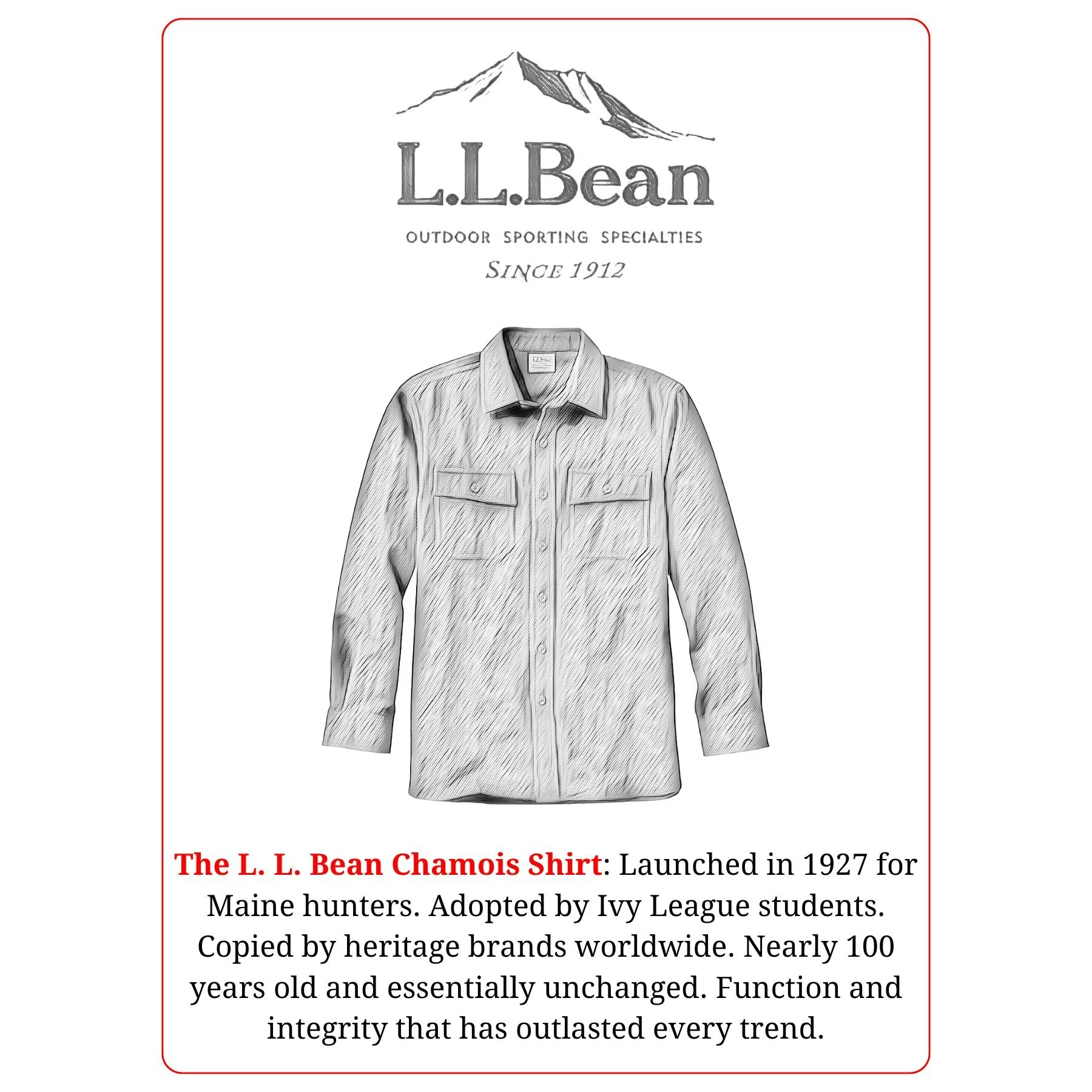
Few garments in the American wardrobe are as quietly essential as the L.L. Bean chamois shirt. Introduced in 1927 as hunting gear for the Maine outdoors, it quickly became a staple. Ivy League students favoured it. So did working hunters. Heritage brands copied it. Nearly a century later, it remains nearly unchanged.
Leon Leonwood Bean introduced the chamois cloth shirt in 1927 as a hunting and outdoor layer for the Maine woods. Soft, napped cotton flannel, brushed to mimic genuine chamois, gave excellent warmth-to-weight and softened with each wash. It worked as a mid-layer under a wax jacket or vest, or alone for chopping wood or walking a trapline. Bean, known for the Maine Hunting Shoe, stayed true to his approach: solve problems for those who work and live outdoors.
In the 1930s and 40s, the chamois shirt appeared in Bean's catalogue as dependable kit. It was popular in New England but not yet a national phenomenon. After World War II, America’s growing appetite for authentic outdoor style changed this. By the 1950s, Ivy League students embraced the chamois shirt as a weekend essential. It fit perfectly alongside chinos, loafers, and the unstudied casualness that defined East Coast collegiate style. Here was a garment with genuine outdoor credentials, available by mail order from an outfitter in Freeport, Maine, not manufactured for fashion purposes.
The chamois shirt reached its cultural peak between the late 1970s and the 1980s. This period marked the convergence of the back-to-the-land movement, the preppy revival, and a growing American nostalgia for authenticity. In 1980, The Official Preppy Handbook cemented L.L. Bean’s status, with the shirt at its core. It appeared on campuses, in suburban households, and increasingly on people who had never set foot in a Maine forest but instinctively understood that the shirt communicated something real: competence, unpretentiousness, a certain inherited ease.
The influence of the chamois shirt is clear in modern menswear. Brushed cotton overshirts by brands like APC, Gitman Vintage, and Pendleton owe much to Bean’s template. That a shirt can serve as outerwear, mid-layer, and casual tailoring is now normal, but the chamois shirt led the way.
Bean has kept the shirt in production, updating the fit slightly while preserving its essence.