
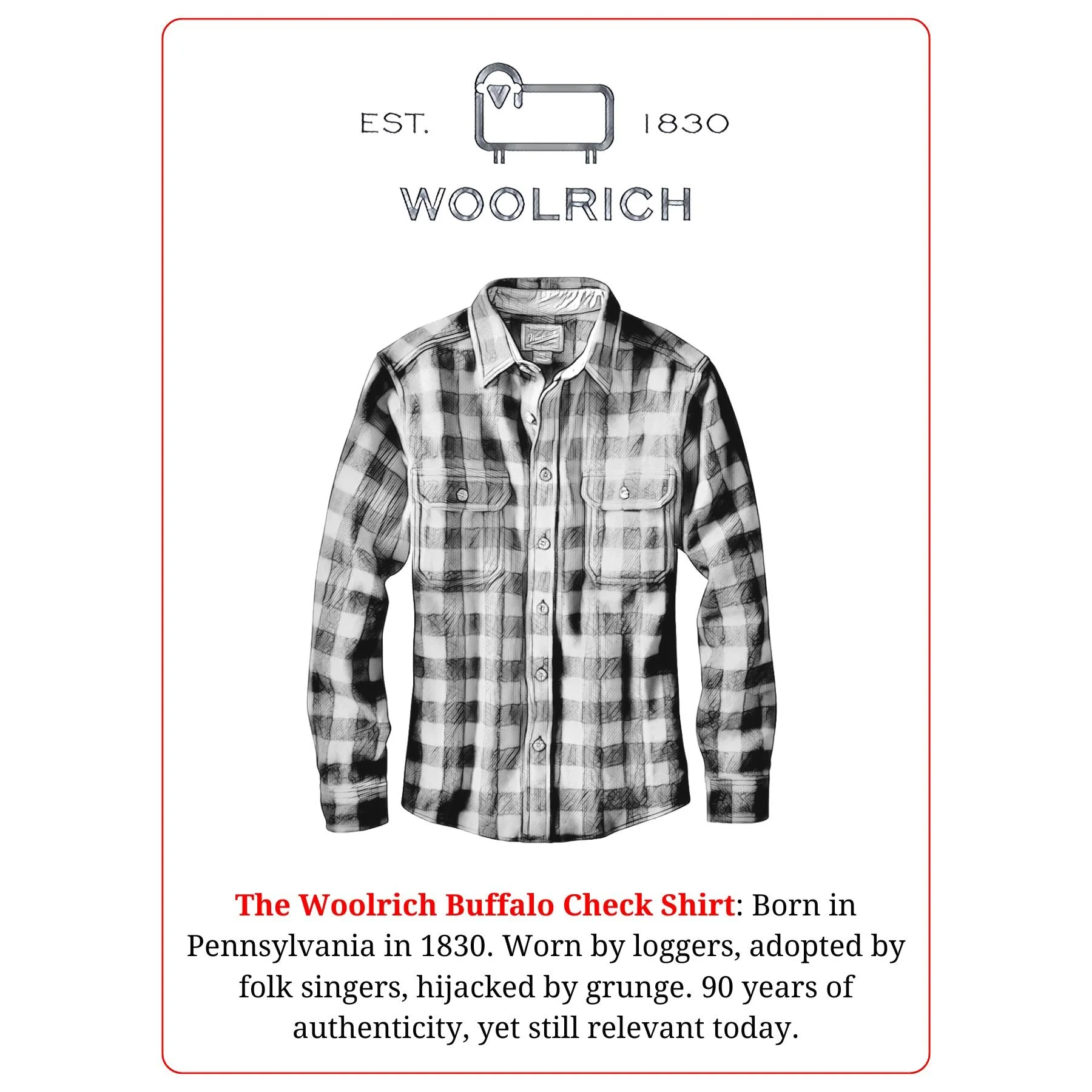
The Woolrich Buffalo check, a bold red-and-black plaid, is one of the most recognisable patterns in American clothing history, having journeyed from Pennsylvania lumber camps to become a global menswear icon.
Woolrich was founded in 1830 by John Rich in Plum Run, Pennsylvania. It is the oldest continually operating woollen mill in America. The company's early customers were loggers, hunters, and trappers who worked the forests of central Pennsylvania. These men required hard-wearing, warm clothing for brutal winters and physical labour. The heavy wool buffalo check shirt emerged from this need. It was designed purely for function. The thick wool retained heat even when wet. The bold pattern made hunters visible to one another in dense woodland. The boxy cut allowed freedom of movement over heavy undergarments.
The pattern predates Woolrich. Large-scale plaids were woven in Scotland and brought to North America by settlers. Similar checks appeared across different manufacturers. Woolrich's version, in the distinct red-and-black colourway, produced at scale and with consistent quality, became the standard.
For its first century, the buffalo check shirt lived exclusively in the working world, serving men who cut timber, worked on farms, or hunted deer in November, men who needed garments that could withstand hard use. Later, Woolrich supplied the US military during both World Wars, further building its reputation for utilitarian excellence.
Postwar, as America urbanised and the frontier faded, the rugged outdoorsman became a romantic figure. The buffalo check shirt came to symbolise a self-reliant, capable masculinity linked to the land.
In the 1950s and 60s, the shirt migrated into counterculture. Folk musicians, beat writers, and a wider movement embraced workwear to reject postwar suburban conformity. Bob Dylan wore it. Kerouac's characters wore it. The garment signified authenticity, anti-consumerism, and a connection to pre-corporate America.
By the 1970s, the lumberjack aesthetic entered mainstream culture via an unlikely route: the gay community in San Francisco and New York adopted flannel and workwear to reclaim hypermasculine imagery.
In the early 1990s, Seattle grunge emerged. Kurt Cobain, Eddie Vedder, and others from the Pacific Northwest wore heavy flannel shirts, often workwear, as an anti-fashion statement. Ironically, this look became the decade's dominant style. Soon, buffalo check appeared everywhere, visible on teenagers who had never been near a logging camp. This period cemented the pattern's place in popular consciousness, introducing it to a generation that now feels strong nostalgia for it.
From the 1990s on, the fashion industry leaned into heritage workwear, making Woolrich a reference for designers chasing authenticity. Collaborations brought the buffalo check to luxury fashion, while Woolrich held to its workwear identity.