
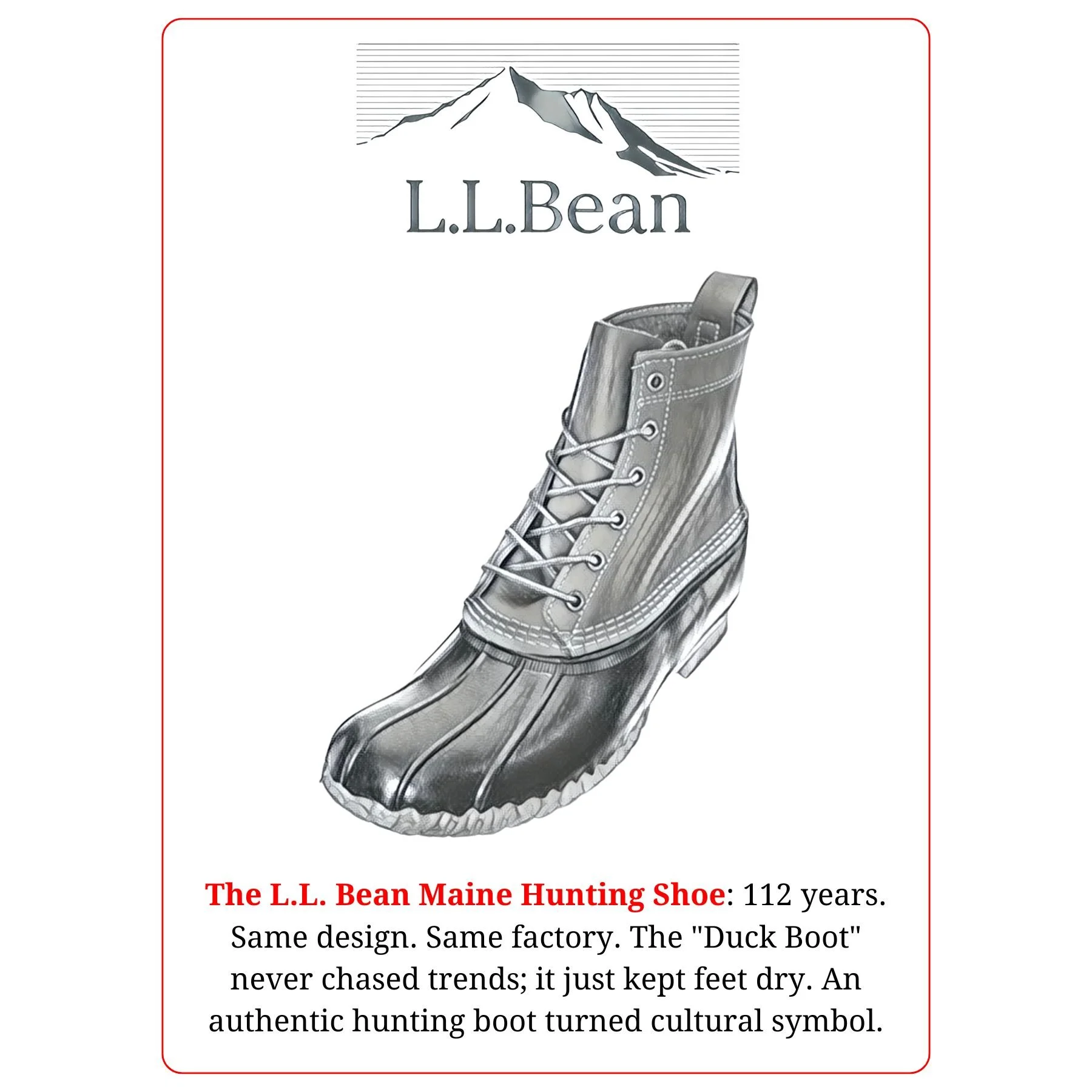
The L.L. Bean Main Hunting Shoe, commonly called the "duck boot", is one of American footwear's most enduring success stories, born from necessity and perfected through iteration.
Leon Leonwood Bean created the boot in 1912 after returning from a hunting trip with cold, wet feet. His solution was to combine leather uppers with rubber bottoms from men's work boots. The hybrid design kept feet dry and provided ankle support, essential for Maine's wet, unpredictable terrain.
The early story nearly ended in disaster. Bean's first batch of 100 boots failed when 90 pairs were returned because the rubber separated from the leather. Instead of abandoning the concept, Bean refined the stitching and manufacturing process, creating the chain-stitch construction that still defines the boot today. He refunded every customer and rebuilt trust through his unconditional guarantee.
The boot's utilitarian design has remained remarkably unchanged for over a century. The rubber bottom extends 6-8 inches up from the sole, protecting against mud and water. The leather upper provides breathability and flexibility. The simple lacing system and moc-toe construction reflect Maine hunting boot traditions.
During the 1980s, the boot became a staple of Ivy League style, especially on northeastern college campuses. Students wore them not for hunting but as casual campus footwear, pairing them with chinos and Oxford shirts. This cemented the boot's association with a New England aesthetic: outdoorsy, unpretentious, and generationally wealthy.
During the 2000s, the "Duck Boot" expanded beyond the preppy scene. Social media and heritage fashion trends sparked unprecedented demand. By 2012, waiting lists stretched for months. The boot appeared everywhere from Brooklyn to Tokyo, worn by people who had never stepped in a marsh. It became a symbol of authentic American heritage, which was ironic since most buyers used them for grocery runs rather than duck hunting.
Today, the boot occupies a unique cultural space. It is both a genuine work boot still used by hunters and outdoorspeople, a prep/trad fashion signifier, a mass-market casual boot, and a symbol of Maine craftsmanship, still made in Brunswick, Maine.
L.L. Bean's focus on manufacturing location, resistance to outsourcing even during peak demand, the unchanged design, and founder mythology became a template for heritage branding.
The boot's chunky, unfashionable silhouette anticipated the current appetite for intentionally unstylish footwear. It proved that functionality and even ugliness could become desirable aesthetic qualities.
The made-to-order model and resulting waitlists created artificial scarcity, increasing desirability, a strategy now common in sneaker and streetwear markets.
The Bean Boot succeeded through regional authenticity, manufacturing transparency, and resistance to trend-chasing, qualities that resonate with customers seeking alternatives to fast fashion's disposability.