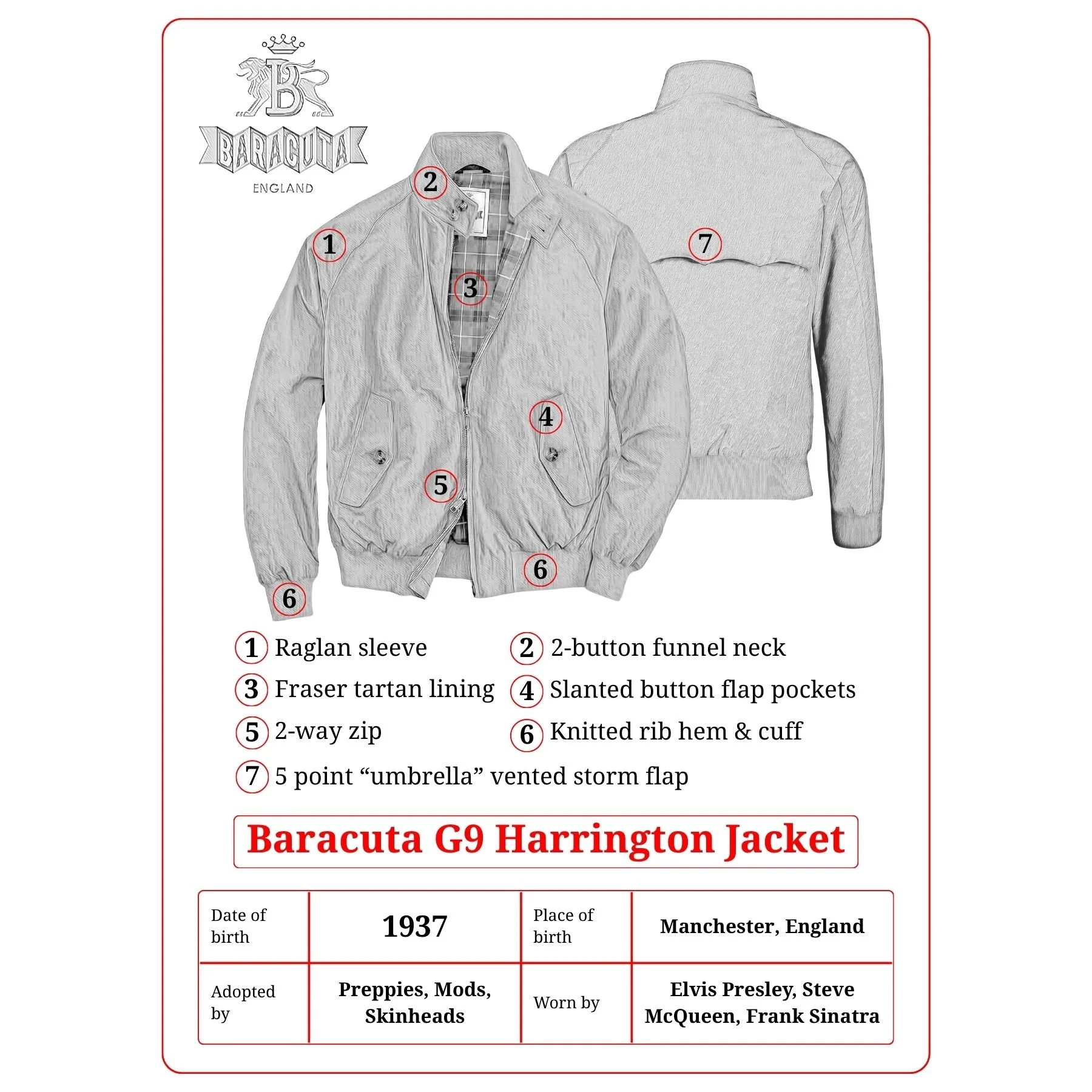
The Baracuta G9 Harrington jacket is one of menswear's most enduring icons, with a fascinating history that spans nearly 90 years and multiple subcultures.
Brothers John and Isaac Miller designed the G9 in 1937 in Manchester, England, for their Baracuta brand. They made it as a practical golf jacket, naming it "G9" for "Golf style 9." The jacket featured a two-piece raglan sleeve for easy movement, a Fraser tartan lining, an umbrella back yoke to keep out rain, and a funnel neck with a two-button throat latch.
The fabric was revolutionary: lightweight, water-resistant cotton poplin, perfect for unpredictable British weather without being heavy or restrictive.
The jacket only became known as the "Harrington" years after it was first made. The name came from the 1960s American TV show Peyton Place, where Ryan O'Neal’s character, Rodney Harrington, often wore the jacket. Over time, this nickname became more popular than the original "G9" name.
During the 1960s, the jacket became popular in American collegiate circles and the Ivy League set, influenced by stars like Elvis Presley and James Dean, who wore similar styles.
Over the decades, the G9 became associated with diverse subcultures, including British Mods and the skinhead movement in its original working-class, multi-racial form, paired with Fred Perry shirts, Levi's jeans, and Doc Martens boots.
The jacket maintained relevance through association with cultural icons like Steve McQueen, who famously wore one in The Thomas Crown Affair and in real life, members of the Rat Pack, and later Britpop bands in the 1990s.
The G9's longevity comes from its versatility; it works equally well in prep, mod, punk, and contemporary casual contexts. Its simple, functional design has remained unchanged for decades, a testament to its original design.
Baracuta still manufactures the G9 today, maintaining many original construction techniques, while the design has been adopted and reinterpreted by countless other brands. It remains a style that is simultaneously functional sportswear, a subcultural identity marker, and a timeless staple.